Forty Years Ago
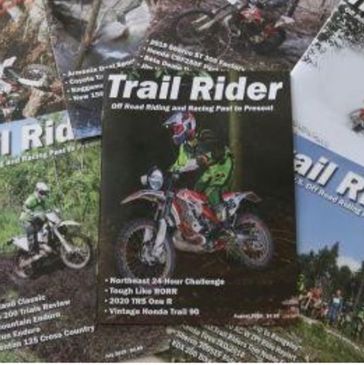
April, 1970: Following the success of Bob Hick’s Cycle Sport newspaper, the New England Trail Rider magazine is created and offered to readers everywhere in New England. In his first “Along My Way” editorial, a very youthful Bob Hicks, slim and obviously sporting the dirt biker’s “farmer’s tan” had this to say about his new magazine:
“Cycle Sport has reached a point of saturation, jammed monthly with news of competition. Precious little room exists now in that magazine for general interest news and reports on just trail riding. And trail riding is becoming a big thing, bigger than you may realize. Our own involvement in trail riding, for pleasure and for sport, is considerable. The amount of material that comes our way, which we feel would be of interest to most trail riders, is also considerable. So we’re starting this new magazine.”
Those were different days, dear readers. We were all riding a wave had begun in the late ‘40s, that we’d only become aware of in the mid ‘50s, and we only started learning how to take advantage of in the early ‘60s. Nearly everybody had a job, a good paying job. The country was in the black. Real estate was relatively cheap, everybody had gotten television and telephones and everyone had a paid vacation or two to look forward too. We were suddenly the richest nation in the world, and we were learning to play.
One of the things we turned into toys were motorcycles. Motorcycle gangs and the bad-boy image of The Wild One be damned; none of that culture was even remotely connected to the flood of cheap, new Japanese trail bikes streaming over the ocean; other than the obvious two-wheeled thing. Word got out that we could ride these new “dirt bikes” off the road in vacant lots and corn fields, and it sounded like a good idea to a relatively large segment of a fun-seeking population. Almost overnight, it seems now, the trail bike boom was born.
But that’s not to say that off-road riding and racing was suddenly born as well. Hey, we’ve got Hertfelder on the back page; he will remind you daily about the days of Harley Davidsons in enduros, and Indians and Triumphs and all those old road tanks converted into off road racers. But that was the hardcore. That was the group that was already being catered to in Cycle Sport, with its coverage of flattracking, enduros, “scrambles”—the origination of what we now call motocross—and every other form of competition dreamed up for any motorcycle you cared to race. Trail Rider was the advance guard of an off-road revolution made easily accessible by the onslaught of Japanese trailbikes in the late ‘60s and early ‘70s.
The Japanese did not start trail riding, make no mistake about that. You were already easily able to get your hands on an Ossa or Bultaco in New England in 1970, probably easier than a Yamaha DT-1 at first. You could also get a Greeves or a Triumph with knobby tires, or a Husqvarna; or one of the new bikes being made by John Penton, as long as you would be satisfied with only 100 or 125cc. Which was not seen as a bad thing back then. After years of playing in the woods with a huge Harley, plenty of guys were eager to try out a 100cc machine that weighed one-third as much as the tank they used to ride. And again, we all had the money to experiment with all these new toys, so why not?
True to his mission, Bob gave a lot of space in his first issue of Trail Rider to reading maps and figuring out where to ride. In the beginning of the magazine there is an index to Geological Survey maps for central New England, and where to buy them; plus there was a feature devoted to the official trail bike policy for the National Forests in New England. Talking about the Green Mountain National Forest in Vermont, and the White Mountain National Forest in New Hampshire, this was said: “In both areas, motorcycles are permitted excepting certain well-defined trails and wilderness areas.” Times have changed, eh? A couple of pages also point out that motorcycles aren’t allowed on the Appalachian Trail, and the Long Trail system in Vermont. It’s funny to think of a time when the riding legality of these two world-famous trails would have to be pointed out!
A competition calendar was also printed in the first issue of Trail Rider, with 16 events on the schedule for 1970. Two events on the calendar ring a bell, the Somers enduro in Somers, CT, which still happens every year today, and the Salmon River Ramble, a name familiar up until a few years ago. Interesting to note that both events were put on by the Rams M.C., who were actually responsible for five enduros on the schedule, including the Monadnock International enduro out of Keene, NH, and the Headless Horseman enduro out of Northampton, Mass. Knowing these areas today, I wonder how difficult it would be to find terrain for an enduro in 2010?
On the other hand, I also wonder about two enduros in Bennington, Vermont, back then, the Bennington enduro and the Catamount enduro, put on by the Green Mountain Riders. That part of Vermont is still relatively quiet. I wonder if enough riding land remains there to resurrect an enduro, only waiting for the attention of a tireless new club?
We could speculate and argue on the ability to put on enduros anywhere today, so we’ll leave that be. What I do want to point out, is that in 1970, at the birth of the New England Trail Rider magazine, NETRA, the New England Trail Rider Association, still did not exist. It would be, soon enough, but not as of this first issue.
An article on setting up your trail bike advises, “If you like, fit an auxiliary ignition coil ready to swap over to should the regular unit give out. By all means use a compression release on a two-stroke, one with a filter to prevent taking in gritty outside air. Downhill braking in mud is best done with the compression release.”
Okay, show of hands: how many people remember what a two-stroke compression release was? It was (is, since you can still get them if you really hunt around the ratty old bike shops) a valve that screwed into the second spark plug hole in your cylinder head (you do have two spark plug holes, don’t you?) that was actuated by a cable and lever at the handlebars. With a compression release, you would pull the lever in and open the release, especially on a downhill, and with the bike in gear and the clutch out you could take advantage of a type of engine braking that wouldn’t immediately result in the rear wheel locking up and coming around on you. A compression release was especially handy, since the first mud puddle you rode through soaked your brakes and left them completely ineffective, and they won’t stop you anyhow.
This first issue of trail rider also mentioned Bud Peck, Al Eames, Piet Boonstra and Dave Latham, among others, all destined to become famous locally and nationally for their participation in this “new” sport of trail riding.
It was the beginning of the glory days, forty years ago. More next month.
February 2nd, 2010 · No Comments
→ No CommentsTags: News